AI Model Closes Gaps in Brain Wiring Maps
The system fills blank regions with plausible neural connections
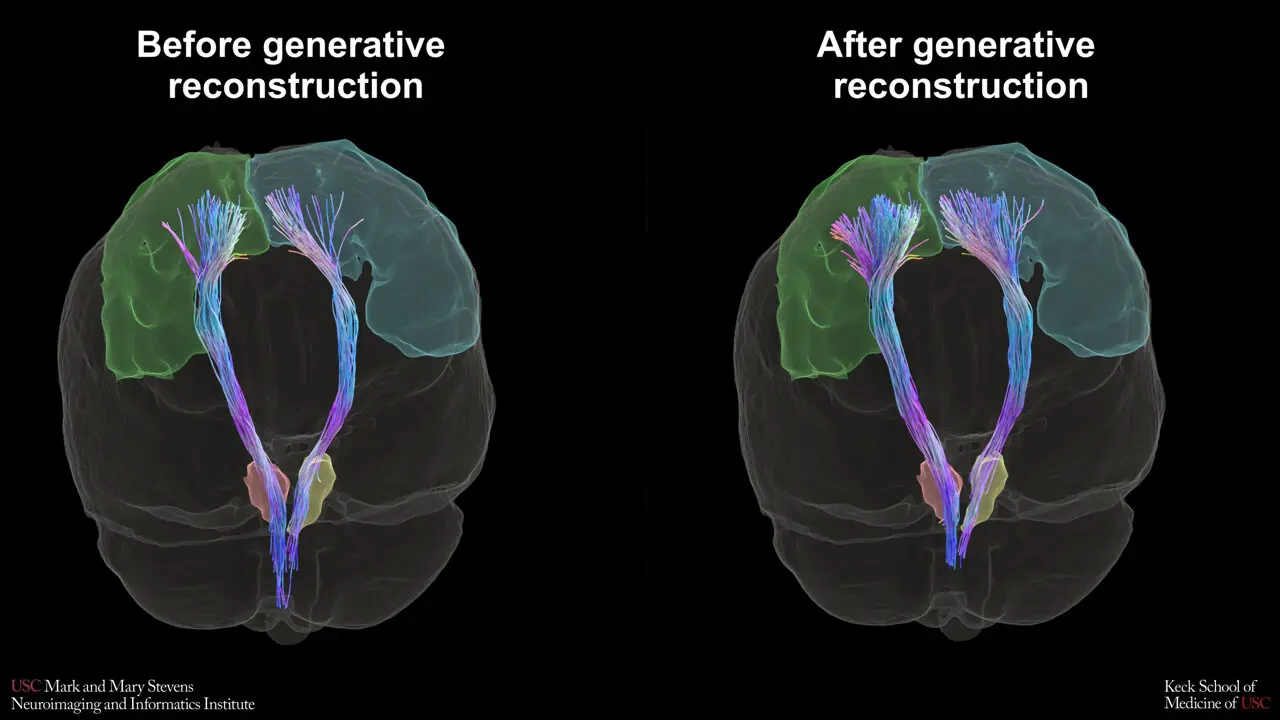
Researchers at the Mark and Mary Stevens Neuroimaging and Informatics Institute at USC's Keck School of Medicine have created a generative AI model. The tool fills in missing data in diffusion MRI scans. These scans map brain connections but often lose signal in certain areas. The AI reconstructs the missing pathways. The team focused on diffusion MRI, which tracks water molecule movement to reveal white matter tracts. Signal loss occurs near skull edges or due to motion. This creates holes in the wiring map. The generative model learns patterns from complete scans. It then predicts what the missing connections should look like. How the AI Learns to Reconstruct Missing Brain Paths The model was trained on thousands of high-quality brain scans. It learned the typical structure of neural pathways. When a new scan has gaps, the AI predicts the missing segments. This approach treats the problem as image inpainting.
Health news
 Exercise and Mood: Italian Study Links Physical Activity to Lower Depression Symptoms
 Screen Time in Childhood Linked to Unexpected Cognitive Boost in Teens, 8‑Year Study Shows
 Workplace stress and anxiety are taking a heavy toll on employees, with one in three workers reporting that the strain is not easing
 Daily Food Habit Tied to Lower Risk of Anxiety and Depression
The system fills blank regions with plausible neural connections. The method relies on the fact that brain wiring follows consistent anatomical rules. The AI internalizes these rules during training. It does not invent random connections. Instead, it generates paths that match known neuroanatomy. This makes the filled-in data reliable for downstream analysis. Why Filling These Gaps Matters for Neuroscience Research Incomplete wiring maps limit what scientists can study. Researchers cannot accurately measure tract integrity or detect subtle changes. The AI-filled maps restore full connectivity information. This enables better studies on brain disorders. It also improves the accuracy of clinical assessments. The team validated the model against expert-drawn references. Results showed the AI predictions closely matched human annotations. The filled regions were anatomically plausible. This validation confirms the tool's reliability for research use. Frequently Asked Questions What type of MRI does this AI model work with?
The model is designed specifically for diffusion MRI scans. These scans map white matter tracts by tracking water diffusion. The AI fills signal-loss gaps in these particular images. How was the model validated for accuracy? Researchers compared AI-generated fills against expert-drawn reference maps. The predictions aligned closely with human annotations. This confirms the tool produces anatomically accurate reconstructions.